Why Freight Carriers Lose Customers at the First Call (and How AI Receptionists Are Stopping It)

The Freight Support Problem Most Carriers Underestimate
Picture this: it’s 7:42 a.m. on a Monday. Your dispatch team is juggling three late loads, a reefer alarm, and back-to-back calls from brokers wanting ETA updates on shipments that left Friday. The phone queue hits six callers. Two hang up after four minutes of music. One of them, a broker who sends you 40 loads a month, quietly routes that freight to a competitor by 8:15 a.m.
You never see it in your revenue report. You never even know it happened.
This scenario plays out hundreds of times a day across mid-size freight carriers in the U.S., Canada, and increasingly in cross-border Mexico lanes. And the cause isn’t driver shortages, fuel costs, or rate compression, it’s something far less dramatic: the first call experience.
According to a 2023 report by Salesforce, 88% of customers say the experience a company provides is as important as its products and services. In freight, where margins are tight and broker loyalty is conditional, that stat carries real operational weight. The AI call assistant category has emerged specifically to address this gap, not as a gimmick, but as a genuine operational layer between inbound call volume and an already-stretched dispatch team.
Why the First Call Matters More Than Most Carriers Think
Modern Freight Customers Expect Instant Visibility and Call When They Don’t Get It
EDI integrations and API-connected visibility platforms have raised shipper expectations. Project44, Samsara, and Macropoint have conditioned brokers and shippers to expect real-time tracking as the default. But technology doesn’t eliminate the need for human (or voice AI) confirmation, it raises the floor.
When automated visibility fails, a GPS ping drops, a TMS update lags, an appointment window goes unconfirmed, brokers call. And what they encounter in that moment shapes how they perceive your operational reliability.
The hard truth: a customer usually cannot distinguish between an operational delay and a communication failure. They experience both as the same thing, a carrier that doesn’t have its act together.
“In logistics, silence is interpreted as a problem. Carriers who communicate proactively, even when the news isn’t great, retain far more business than those who go quiet under pressure.”
– Dr. Chris Caplice, Executive Director, MIT Center for Transportation & Logistics
Dispatch Teams Are Buried Under Repetitive, Low-Judgment Requests
The calls that flood inbound queues during peak dispatch hours are rarely complex. They follow a predictable pattern: ETA checks, POD requests, terminal hours inquiries, detention questions, delivery confirmations. Each call is individually minor. Collectively, they consume hours that your most skilled people could spend on load planning, spot quoting, exception management, and broker relationship work.
A FreightWaves survey found that dispatchers at mid-size carriers spend between 25% and 35% of their shift responding to inbound status calls that, in most cases, require nothing more than a TMS lookup and a read-back. That’s not dispatcher work. That’s data retrieval. And it’s costing you capacity you can’t afford to waste.
Missed Calls Are Quietly Destroying Carrier Relationships
After-hours calls go to voicemail. Abandoned calls disappear from reporting. Missed quote requests never become loads. These aren’t dramatic failures, they’re slow, invisible erosion of the broker trust that took years to build.
Consider the compounding effect: a broker calls after hours about a load in transit, gets voicemail, calls a competitor, gets an answer, and starts mentally recalibrating which carrier they call first next week. Your rates didn’t change, service didn’t change. Your communication did, and that was enough.
The 4 Operational Failures That Hurt Freight Customer Experience
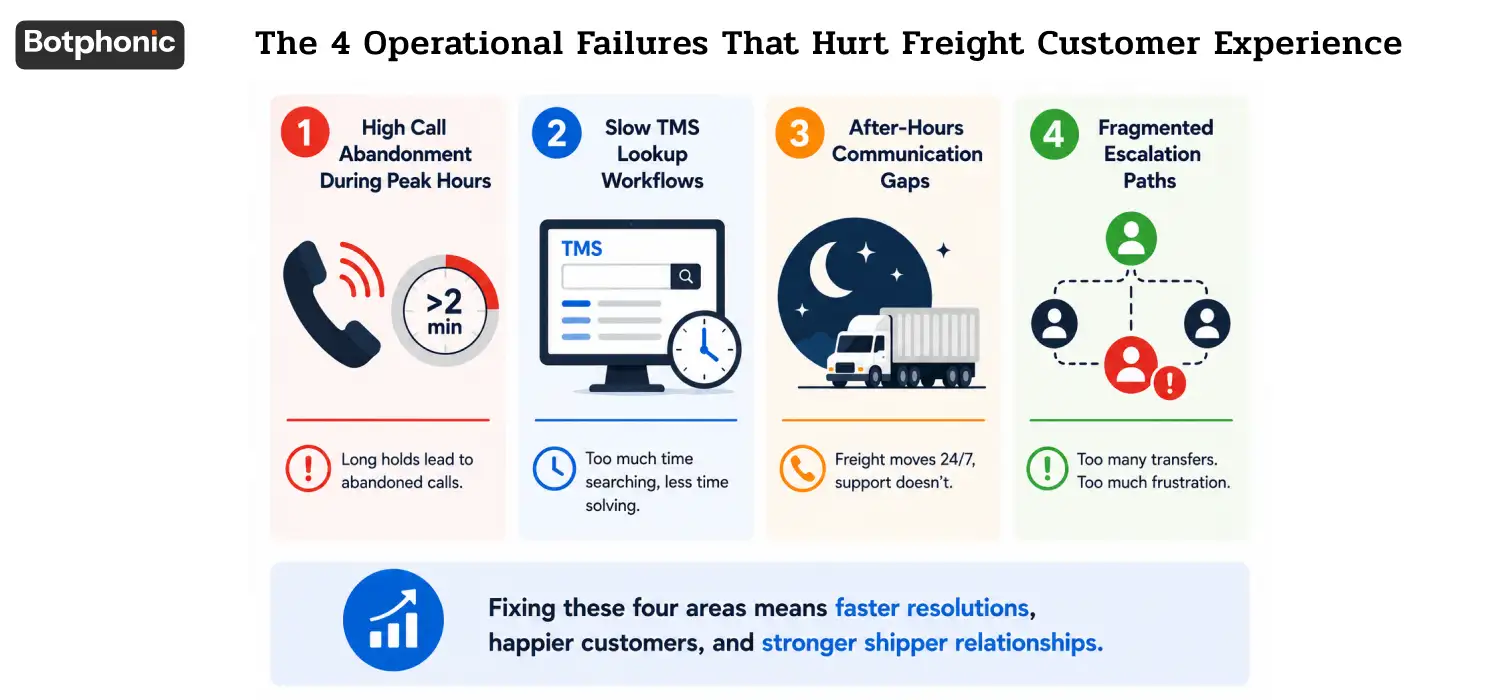
1. High Call Abandonment During Peak Hours
Morning dispatch windows, roughly 6:30 a.m. to 9:30 a.m. in most freight markets, create predictable bottlenecks. CSR queues fill faster than agents can clear them. According to Talkdesk’s Global Contact Center KPI Benchmarking Report, the average acceptable hold time before a caller abandons is under 2 minutes, while the average hold time in transportation and logistics contact centers runs closer to 4–6 minutes during peak periods.
What carriers almost universally miss: abandoned calls almost never appear in revenue reporting. There’s no line item for “broker we lost to hold music.” That invisibility makes the problem easy to deprioritize, until relationship damage becomes too obvious to ignore.
2. Slow TMS Lookup Workflows
When a human agent takes an inbound status call, the workflow typically looks like this: answer, verify caller identity, ask for PRO or load number, attempt to spell alphanumeric references correctly, search TMS, read back information, close call. Across 40–60 inbound calls a day, the cumulative time spent on TMS data retrieval, rather than actual problem resolution, is significant.
Agents aren’t doing anything wrong. The workflow is just designed in a way that wastes their most valuable capacity: judgment, empathy, and escalation skill.
3. After-Hours Communication Gaps
Freight doesn’t pause at 5:00 p.m. Refrigerated loads move overnight. Cross-border shipments encounter delays on weekend mornings. Detention disputes need documentation at 11:00 p.m. when a receiver is refusing to release a driver.
Most carrier support coverage does not match the operational reality of continuous freight movement. The gap between when freight needs attention and when a human agent is available creates real shipper confidence erosion, and it accumulates invisibly, one missed callback at a time.
4. Fragmented Escalation Paths
Nothing compounds customer frustration faster than being transferred repeatedly while having to re-explain a situation from scratch. A broker calling about a damaged shipment should not have to repeat PRO numbers, carrier references, and delivery addresses to three different people before reaching someone with authority to act.
Fragmented escalation paths signal to the customer that your operation lacks coordination. Even when the underlying issue is resolvable, the experience of navigating your phone tree leaves a lasting negative impression.
Where AI Receptionists Actually Help Freight Operations
An AI receptionist for freight customer support isn’t a chatbot dressed up with a voice. Done correctly, it’s an operational intake layer that handles high-volume, low-judgment requests immediately 24 hours a day, while ensuring complex or urgent situations reach a human quickly and with full context preserved.
Immediate Call Intake and Verification
The moment a call connects, a well-configured AI receptionist software can identify the caller, capture load references in natural language (including alphanumeric PRO numbers), and pull relevant shipment data, without placing the caller on hold. The goal isn’t to replace your dispatch team. It’s to ensure that the 60% of calls that require nothing more than a status update never reach your dispatch team at all.
“The carriers winning broker relationships right now are the ones who’ve figured out that speed of response is part of the product, not a nice-to-have.”
– Zach Strickland, Head of Market Intelligence, FreightWaves
Handling Repetitive Freight Support Requests
The requests in the top half of that table consume the majority of inbound call volume. They also require the least operational judgment. AI voice systems are well-suited to handle them, not because AI is infallible, but because these calls follow predictable patterns that integrate cleanly with TMS data.
Explore logistic solutions purpose-built for this workflow to understand how AI intake integrates with freight-specific systems.
Escalating Operational Exceptions Faster, Not Slower
The fear most dispatch managers have about voice AI is that it will delay escalation when something serious happens. That fear is legitimate, and it’s exactly why escalation logic is the most important configuration decision in any deployment.
Strong AI systems are designed to detect urgency signals, specific keywords, caller tone, load context, and route immediately to the correct human queue with the full conversation transcript preserved. A driver calling about a reefer alarm should never spend 90 seconds on an automated status flow. The system should recognize the situation and connect directly, fast.
PRO TIP :
When evaluating AI receptionist vendors, test their escalation speed specifically. Ask them to demonstrate what happens when a caller says “the cargo is damaged” or “I need a manager now” in the middle of a status inquiry. If the system continues the scripted flow, that’s a disqualifying failure.
The Technical Infrastructure Behind Reliable Freight Voice AI
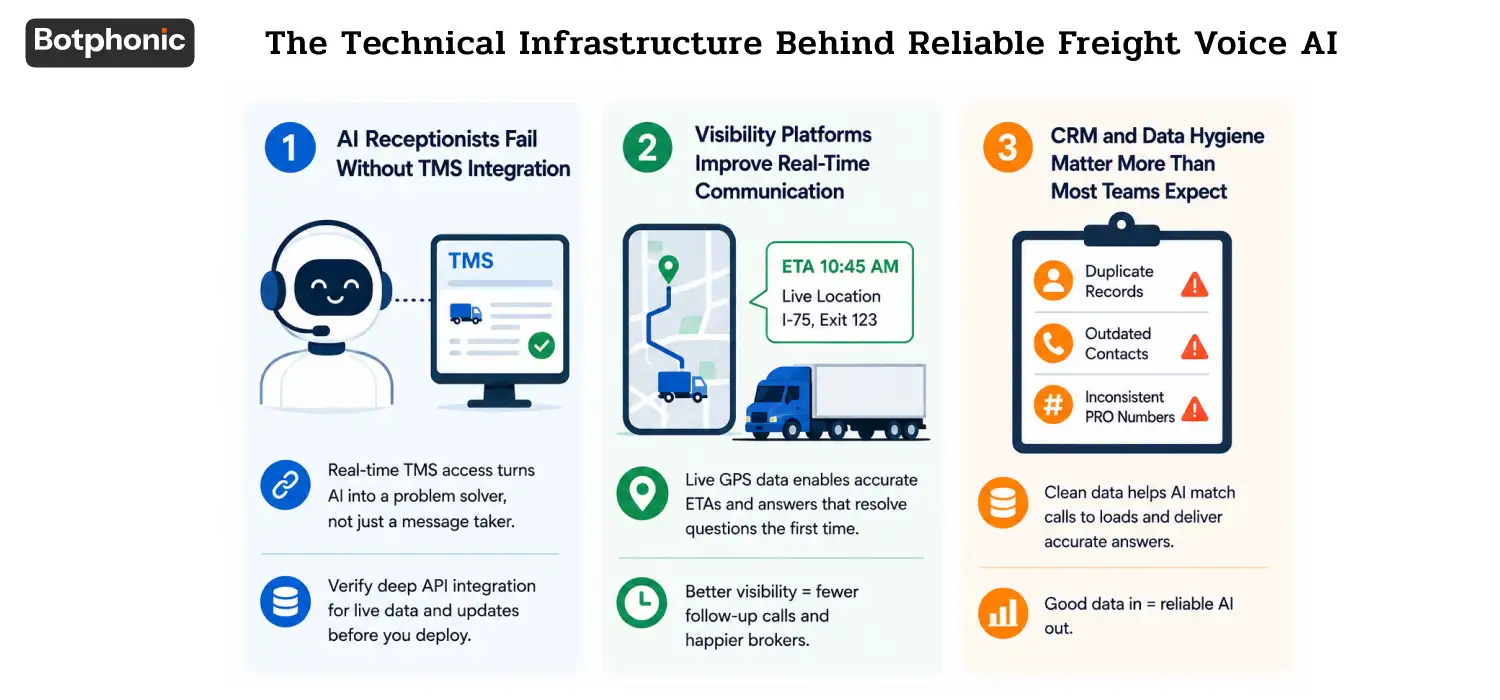
1. AI Receptionists Fail Without TMS Integration
The difference between a useful AI receptionist for freight customer support and an expensive voicemail system is TMS integration. Without real-time access to shipment data, an AI can only collect information, it can’t actually resolve status questions.
Carriers running McLeod Software, TMW Systems, or Rose Rocket should verify that any AI voice platform can pull live load data through API or webhook before committing to a deployment. Integrations vary significantly in depth. Some platforms offer read-only status access; others support bidirectional data flow that allows the AI to update appointment notes or flag shipments for exception review.
2. Visibility Platforms Improve Real-Time Communication
When AI systems can access live GPS data from platforms like project44, Samsara, or Macropoint, the quality of automated status responses improves substantially. Instead of returning a static TMS timestamp, the system can provide a calculated ETA based on current location and traffic, the kind of specific, useful answer that actually resolves a broker’s question rather than prompting a follow-up call.
3. CRM and Data Hygiene Matter More Than Most Teams Expect
AI receptionist for freight customer support surface data problems that human agents quietly work around. Duplicate shipment records, outdated broker contact information, inconsistent PRO number formatting, these friction points become visible and disruptive when an automated system tries to match inbound calls to load records at scale.
NOTE :
Before deploying any AI receptionist, conduct a data hygiene audit of your TMS and CRM records. It will save significant configuration headaches and improve AI performance from day one.
What Freight Teams Should Evaluate Before Deployment
Noise and Speech Recognition Accuracy
Drivers call from truck cabs. There’s highway noise, Bluetooth distortion, and the kind of background audio that challenges even experienced human agents. Ask your vendor to transcribe this reference phrase in a noisy environment:
“Load 7-Bravo-9-Delta, arriving terminal 14, driver’s asking about detention.”
If the system misreads the alphanumeric reference or drops the terminal number, it will create, not reduce friction in your support workflow.
Escalation Logic and Human Override
The system must allow immediate human transfer at any point in the conversation. More specifically, it must stop scripted flows when it detects emergency language, and it must preserve the full conversation context when handing off to a live agent. A dispatcher who inherits a call without knowing what was already discussed is starting from zero. That’s not an improvement.
Operational Reporting and QA
Track these metrics before and after deployment to measure real impact:
The Human Role Does Not Disappear
Deploying an AI receptionist is not a workforce reduction strategy, it’s a workforce reallocation strategy. When repetitive status calls are handled automatically, dispatchers shift from information retrieval to exception resolution, broker retention, capacity management, and revenue-generating activity. That’s a better use of skilled people, and experienced dispatch managers recognize it quickly.
The rollout challenge isn’t technology, it’s change management. Frontline teams sometimes interpret AI adoption as a threat rather than a tool. Carriers who take time to explain the “why,” involve dispatch staff in workflow design, and demonstrate concrete reduction in interruption load see faster and more sustainable adoption than those who treat deployment as a top-down IT initiative.
The operational truth worth repeating: Poor implementation damages trust faster than poor technology. The system can be excellent and still fail if the rollout isn’t handled with care.
Better Freight Communication Starts at the First Call
Freight carriers rarely lose customers because of a single catastrophic mistake. They lose trust through accumulated friction, slow callbacks, abandoned hold queues, after-hours silence, and dispatchers too buried in status calls to focus on the relationships that actually grow the business.
An AI receptionist for freight customer support addresses the specific operational gap where most carrier-broker trust erodes: the first call. When that call is answered instantly, the status question is resolved in under a minute, and the exception is routed to the right person with full context intact, the customer experience improves without adding headcount.
In logistics, responsiveness is part of the product. Carriers who treat communication infrastructure as seriously as equipment maintenance are building the kind of operational reputation that brokers and shippers don’t walk away from easily.


Comments
Post a Comment