Insurance Agents Report 22% Fewer Missed Leads After Switching to AI Receptionists What Changed

Executive Summary: The Data Behind the 22% Drop
Independent insurance agencies have long operated on a fragile assumption: that office hours are enough. They’re not.
Agencies that deployed a purpose-built AI receptionist for insurance reported, on average, a 22% reduction in missed leads not by hiring more staff, but by closing the leaks in their intake pipeline with conversational AI running 24/7/365.
What created that 22%? The elimination of compounding failure points: the after-hours blind spot, the simultaneous-call bottleneck, IVR friction, and the cold-lead problem caused by slow response. Each contributed a slice of lost revenue. Together, they represented roughly one in five prospects that walked in the front door and slipped out the back.
High Stakes & High Emotions: Why Insurance Calls Don’t Go to Voicemail
The Psychology of the Panic Call
Insurance is not a product category. It is an emotional safety net and when that net is tested, the response is visceral, immediate, and urgent.
Think about the moment a prospect picks up the phone. Their roof is actively leaking. Their car is crumpled on the highway. They’ve just received a legal notice. That call is driven by fear and financial anxiety. A prospect who hits voicemail in that state doesn’t wait patiently they Google the next agency and call that number.
This is fundamentally different from a retail or home services inquiry. Insurance callers are almost always in crisis mode, and the emotional window for capturing that lead is measured in minutes not hours.
The 5 Minute Window
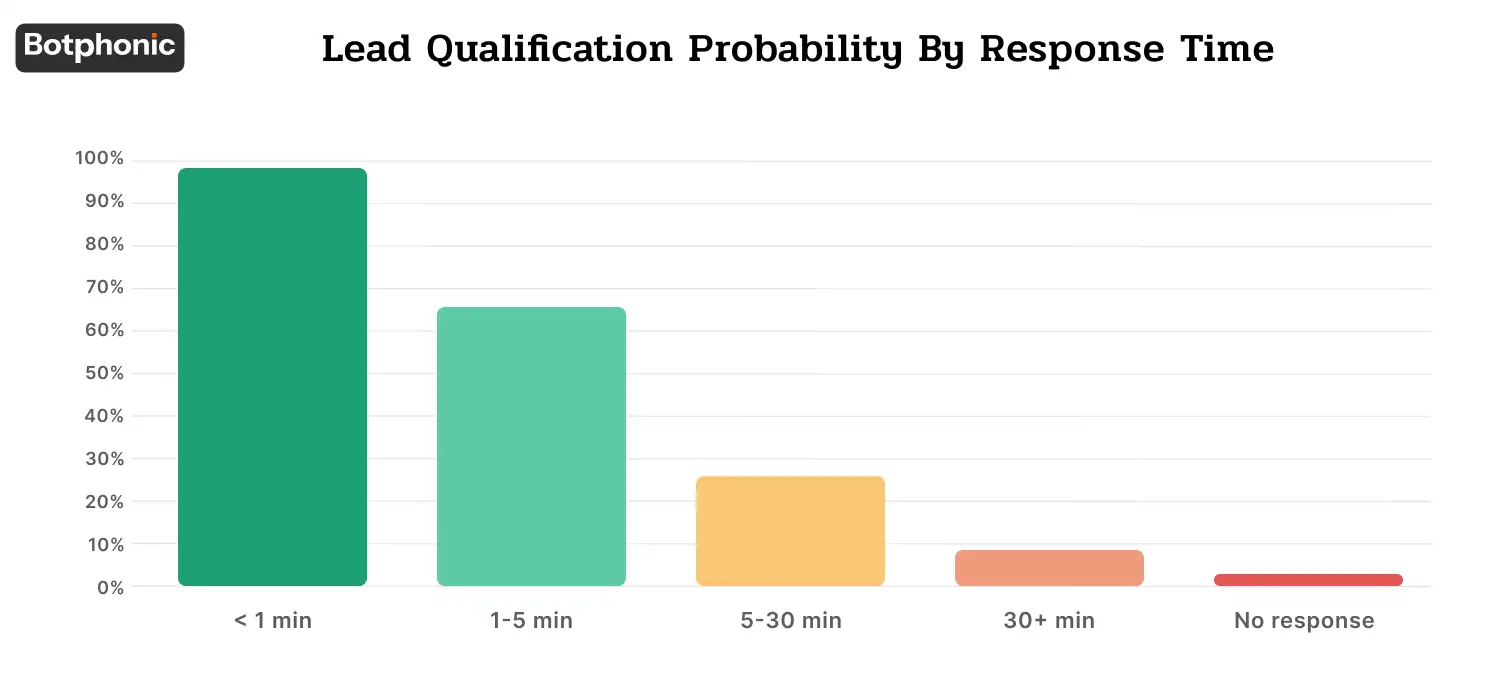
The Speed-to-Lead rule is punishing across all service industries but uniquely devastating in insurance. Research consistently shows that waiting more than five minutes to respond drops your lead qualification probability by up to 80%.
In insurance, the stakes are amplified further:
- 78% of insurance shoppers call an agency after an online search — meaning they already have competitor tabs open
- 47% of all insurance inquiries occur outside traditional business hours — squarely in the dead zone for most agencies
- Peak quote requests hit between 6 PM and 8 PM on weekday evenings — when most agencies are closed
Lead qualification probability by response time
The 5-minute rule how fast response time collapses conversion (Close.com, Lead Advisors)
The Cost of “Ghosting” Renewals
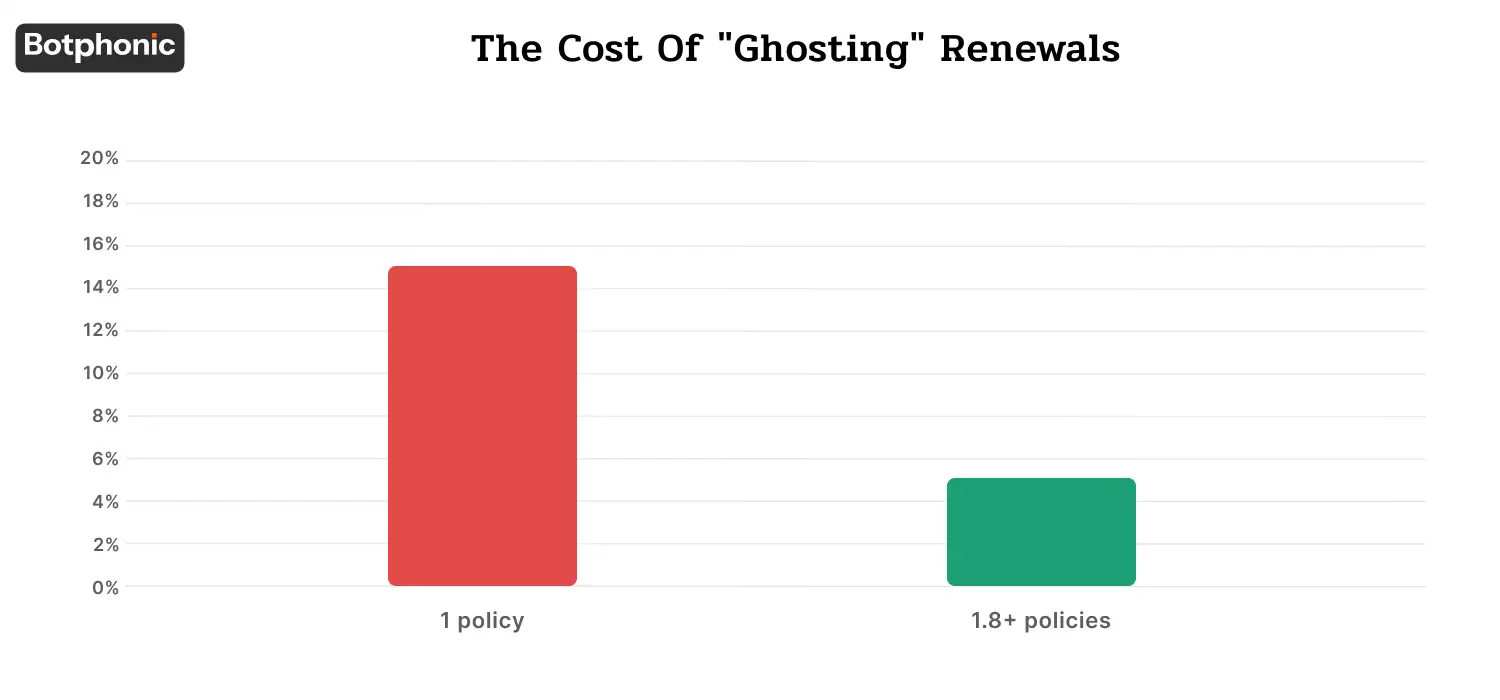
Missed calls during renewal season carry a multiplier effect. A missed renewal call isn’t a $0 outcome it’s a negative one: the loss of multi-year premium income, referral potential, and cross-sell revenue.
Research shows that silent churn accounts for approximately 70% of all customer attrition in the insurance industry. Clients don’t always call to say goodbye but they call during the renewal window with questions. If that call goes unanswered, the path of least resistance is shopping elsewhere.
A customer with one policy churns at 15% annually. A customer with 1.8+ policies churns at just 5% annually. (SuperAgent Research). Every missed renewal call accelerates that first-category churn.
Inside the Silicon Brain: What Makes a Virtual Assistant “Insurance-Fluent”?
Kill the Touch-Tone: Why “Press 1 for Claims” is Killing Your Retention
The traditional IVR “Press 1 for claims, Press 2 for billing” was built when agencies had no alternative. That era is over.
An anxious caller who just witnessed their car get totaled does not want to navigate a menu. Every second they spend pressing buttons compounds frustration and increases call abandonment. Zendesk’s Benchmark data shows the average U.S. SMB loses $450 per missed or abandoned call and IVR-induced abandonment counts.
Conversational AI replaces rigid menus with natural dialogue: “Hi, are you calling about a claim, a new quote, or your existing policy?” The caller answers in their own words. The AI comprehends, routes, and acts no buttons pressed. Callers who feel heard stay on the line.
“Companies adopting voice AI agents have seen up to a 40% reduction in operational costs while handling 90% of customer queries without human intervention.” – Retell AI Research, 2024
Speaking the Language of Risk: The P&C Knowledge Base Advantage
Most general-purpose virtual assistants fail in insurance for one reason: they don’t understand the language. Terms like binding authority, subrogation, UM/UIM coverage, surplus lines, and COIs don’t compute for a generic bot and a caller who hears a confused AI quickly loses confidence in the entire agency.
The best AI receptionist solutions for insurance agencies arrive pre-trained on P&C knowledge bases policy types, claims terminology, carrier concepts, and compliance language — without a single day of onboarding.
The Autonomous Intake: Pre-Qualifying Prospects on Auto-Pilot
Traditional intake: caller says “I need a quote,” receptionist takes a name and number, producer calls back cold.
AI-powered intake: caller says “I need a quote,” the AI systematically captures asset details, current coverage limits, risk exposures, urgency indicators (closing date, lapse date), and prior claims history before a human is ever involved.
By the time the producer picks up, they have a warm, pre-qualified lead with a structured summary. Not a cold callback with a name and nothing else.
A regional P&C agency with 15 agents found producers were spending an average of 2.5 hours daily on routine administrative tasks before AI intake automation. (Sonant AI Case Study)
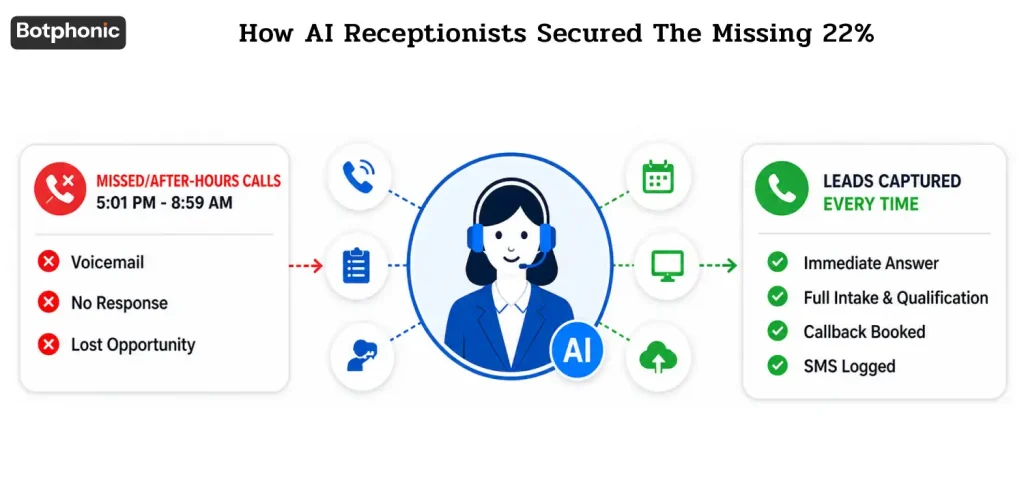
How AI Receptionists Secured the Missing 22%
Capturing After-Hours & Weekend Emergencies: Monetizing the 5:01 PM to 8:59 AM Blind Spot
This is where the most recoverable revenue lives. 47% of insurance inquiries occur outside business hours, and 85% of callers who hit voicemail never call back.
The 5 PM to 9 AM window evenings, overnights, weekends, holidays is your highest-volume unmonitored lead period. An AI-powered receptionist working that window:
- Answers immediately no rings, no voicemail
- Conducts full intake and qualifies urgency
- Books the callback directly into the producer’s calendar
- Logs everything to your AMS before the producer’s morning coffee
Managing the “Spike”: Handling Infinite Simultaneous Calls
Two scenarios expose every human-staffed phone system: catastrophic weather events and open enrollment surges.
A hailstorm hits. Within 90 minutes, 40 simultaneous calls flood your lines. Your two-person team handles 2. The other 38 hit busy signals and your competitor’s AI answers every single one.
An AI receptionist has no practical limit on simultaneous calls. Zero busy signals. Zero abandoned callers.
Hyper-Local Responsiveness (GEO Optimization)
Based on the caller’s area code or stated zip code, the AI personal assistant for Insurance Agents route calls to the agent assigned to that territory, flags regional coverage nuances (coastal wind exclusions, earthquake riders), and books callbacks with the locally licensed producer. This matters for efficiency and for E&O compliance.
Guarding the Heart of Your Agency: Knowing When to Automate and When to Step In
The Panic Button Threshold: Turning AI Triage into Warm Transfers
The most sophisticated thing an AI receptionist does isn’t handle the call — it’s knowing when not to.
Modern AI uses emotional and situational trigger detection: elevated speech pace, distress keywords (“my house is on fire,” “someone is injured”), or live coverage ambiguity in an emergency. When these fire, the AI immediately transfers to a human producer with a full call summary pre-delivered so the producer picks up with context, not cold.
“The agencies winning in 2025 recognize that client expectations have permanently shifted toward instant engagement.”– Sonant AI
Starve the Busywork, Feed the Producers
Your highest-earning producers are spending time on COI issuance, ID card resends, billing updates, and payment status checks. Every one of these has zero sales value and high repeatability the exact profile that AI automation handles flawlessly.
A producer who handles 30 of these per week at 8 minutes each loses 4 hours weekly to tasks that generate zero commission. Across a 10-producer agency, that’s one full-time equivalent consumed by busywork permanently freed by AI.
Seamless Tech Stack Integration: Connecting to Your Agency Management System (AMS)
Real-Time CRM Synchronization
An AI receptionist that captures rich intake data is only valuable if that data flows automatically into your existing systems. Modern platforms integrate natively with Applied Epic, Vertafore AMS360, HawkSoft, and Salesforce Insurance Cloud auto-creating contacts, logging call notes, attaching transcripts, and triggering workflows without manual entry.
A producer opens their AMS in the morning and sees every after-hours interaction already logged caller name, nature of inquiry, urgency level, relevant policy data all populated automatically.
Calendar Syncing for Quotes
Traditional path: call received → note taken → phone tag → meeting booked 2–3 days later → lead is cold.
AI path: call received → intake completed → caller books directly from available slots → appointment confirmed in producer’s Google Calendar or Outlook → producer wakes up to a pre-filled brief attached to the meeting.
Delayed booking sequences lose up to 60% of leads before the meeting ever happens. Booking during the original call while intent is at its peak is the single highest-conversion action in the lead pipeline.
The 24/7 Risk Shield: Defending Your Agency Against “He-Said, She-Said” Liability
Navigating SOC 2, HIPAA, and Panic-Driven Data
Insurance calls frequently carry sensitive data: SSNs, medical history, property values, and financial disclosures. When that call comes in at 11 PM from a panicked policyholder, the risk of rushed, improperly handled data collection is significant. A compliant AI receptionist handles this with encrypted recording meeting SOC 2 Type II standards, HIPAA-adjacent handling for health-adjacent lines, and state-specific disclosure scripting built into every call by default.
PRO TIP :
Ask any AI receptionist vendor for their SOC 2 Type II audit report before deployment. For agencies handling health-adjacent data, require written confirmation of HIPAA-compatible handling. These are E&O risk management essentials, not nice-to-haves.
The Midnight Audit Trail: How Instant CRM Logs Prevent Costly E&O Hallucinations
The nightmare scenario: a client calls at 2:00 AM during a weather event claiming they asked to bind flood coverage. No one answered. Damage occurred at 6:00 AM. Now they’re filing an E&O claim, and you have nothing but a voicemail timestamp to defend yourself with.
An AI customer service creates an instantaneous, immutable audit trail: word-for-word transcripts time-stamped to the second, intent classification, and an escalation record all logged automatically to your AMS. When the E&O claim comes, your defense is a court-admissible transcript, not a memory.
Conclusion: The 22% Margin Will Your Agency Adapt or Go to Voicemail?
The Cost of Absolute Silence
The 22% of leads that agencies were missing before AI adoption weren’t waiting. They were clicking the next search result and in insurance, where emotional stakes are highest, that next result is often a direct writer with a 24/7 digital experience that a human-staffed independent agency simply cannot replicate.
76% of insurance companies implemented generative AI by mid-2024 but only 10% achieved scaled deployment. The early adopters are capturing market share while competitors debate whether to act.
Scaling Without the Overhead
An AI receptionist bridges the 24/7 gap without bloating payroll. No night-shift receptionist, no overtime during open enrollment. No scrambling during weather surges. Your producers sleep, sell, and build relationships while the AI captures every lead, logs every interaction, and defends every potential E&O exposure.


Comments
Post a Comment