How School Offices Are Responding to Parent Calls Instantly; Without Adding Staff

What You’ll Learn
- How AI receptionists answer parent calls instantly without adding front-office staff
- Why traditional phone systems struggle during peak school hours
- What makes a school-grade AI phone system different from IVRs and generic chatbots
- How FERPA-compliant AI call handling protects student data
- How schools manage enrollment surges, snow days, and dismissal changes with AI
- Real-world use cases for attendance, multilingual support, and emergency escalation
- How to evaluate the ROI of an AI receptionist for your school or district
An AI receptionist for schools is an automated, FERPA-compliant voice system that handles routine parent calls, absences, dismissal changes, bus questions, without a human picking up. It is built for K–12 administrators and district IT directors to reduce call volume and front-office burnout. The system answers every call and ensures no one waits on hold at 8:04 AM.
What Is an AI Receptionist for Schools and Why Does the Morning Rush Break Traditional Systems?
An AI receptionist for schools is a cloud-hosted, natural language voice automation layer that intercepts inbound calls before they reach front-office staff. Here is what that means for your front office: staff stop functioning as human call routers and return to direct student support.
The morning bottleneck is not a staffing failure. It is a design failure.
Between 7:45 and 8:30 AM, a typical elementary school front desk simultaneously manages late check-ins, absence calls, bus confirmations, and supply-list questions. According to research by the American Association of School Administrators (AASA), routine administrative calls average 3.2 minutes per call when handled manually by front-office personnel.
A school receiving 40 calls in that 45-minute window consumes 128 minutes of staff labor before the first bell rings. That is more than two full employee-hours spent on calls that a voice AI system can resolve in under 60 seconds each.
What an AI school receptionist does: It accepts, interprets, and resolves inbound parent calls using a large language model (LLM) fine-tuned on K–12 communication scenarios, operating without hold queues, voicemail, or additional headcount.
How Does a School-Grade AI Phone System Differ From a Standard IVR or Generic Chatbot?
A school-grade AI receptionist differs from a legacy IVR or a repurposed retail chatbot in three measurable dimensions: intent recognition accuracy, regulatory compliance architecture, and student information system (SIS) integration depth. Here is what that means for district decision-makers: the gap is technical and legal, not cosmetic.
PRO TIP:
Before deployment, review your top 20 call reasons from the past school year. This helps configure AI call flows that deliver faster resolution rates from day one.
Why Do Legacy IVR Systems and Generic AI Tools Fail in K–12 Environments?
Legacy IVR systems operate on DTMF (dual-tone multi-frequency) keypad routing. They cannot parse natural language input such as “My son needs an early dismissal for his IEP re-evaluation” or “Is there a delayed opening due to the weather forecast?” Calls requiring natural language interpretation fall through to a human operator, which eliminates the efficiency gain.
Generic AI tools trained on retail or customer service corpora share the same structural weakness. They carry no domain knowledge of truancy reporting windows, IDEA Part B IEP accommodation timelines, FERPA data-handling obligations, authorized pickup lists, or early dismissal cut-off protocols. Misclassified intents produce incorrect call resolutions and potential compliance exposure.
Proprietary Feature Comparison: Legacy IVR vs. Generic AI vs. School-Grade AI
Legacy IVR systems offer low resolution rates and limited functionality, while generic retail-trained AI improves performance slightly but often struggles with education-specific use cases and compliance requirements. In contrast, school-grade AI solutions like Botphonic deliver significantly higher resolution rates, built-in FERPA/COPPA-aligned workflows, multilingual support, SIS integration, and structured emergency escalation, making them far more suitable for K–12 environments.Is an AI Answering Service for Schools Actually FERPA Compliant?
A FERPA compliant AI answering service must satisfy the federal “school official” exception under 34 C.F.R. § 99.31(a)(1), which authorizes access to education records by contractors operating under direct school control with a legitimate educational interest. The AI system must not store, re-disclose, or act on student data outside the district’s defined governance boundaries.
What Are the Specific Legal Requirements Under the FERPA “School Official” Exception?
Under 20 U.S.C. § 1232g and its implementing regulations at 34 C.F.R. Part 99, a school may share student education records with a third-party technology provider when all three conditions are satisfied:
- The provider performs a service the school would otherwise perform using its own employees
- The school retains direct control over the provider’s use and maintenance of education records
- The contract prohibits the provider from re-disclosing records for any unauthorized purpose.
Botphonic satisfies all three conditions and provides a Business Associate Agreement (BAA) executed at the district level prior to deployment.
What Is the Technical Data Architecture That Keeps Student Records Protected?
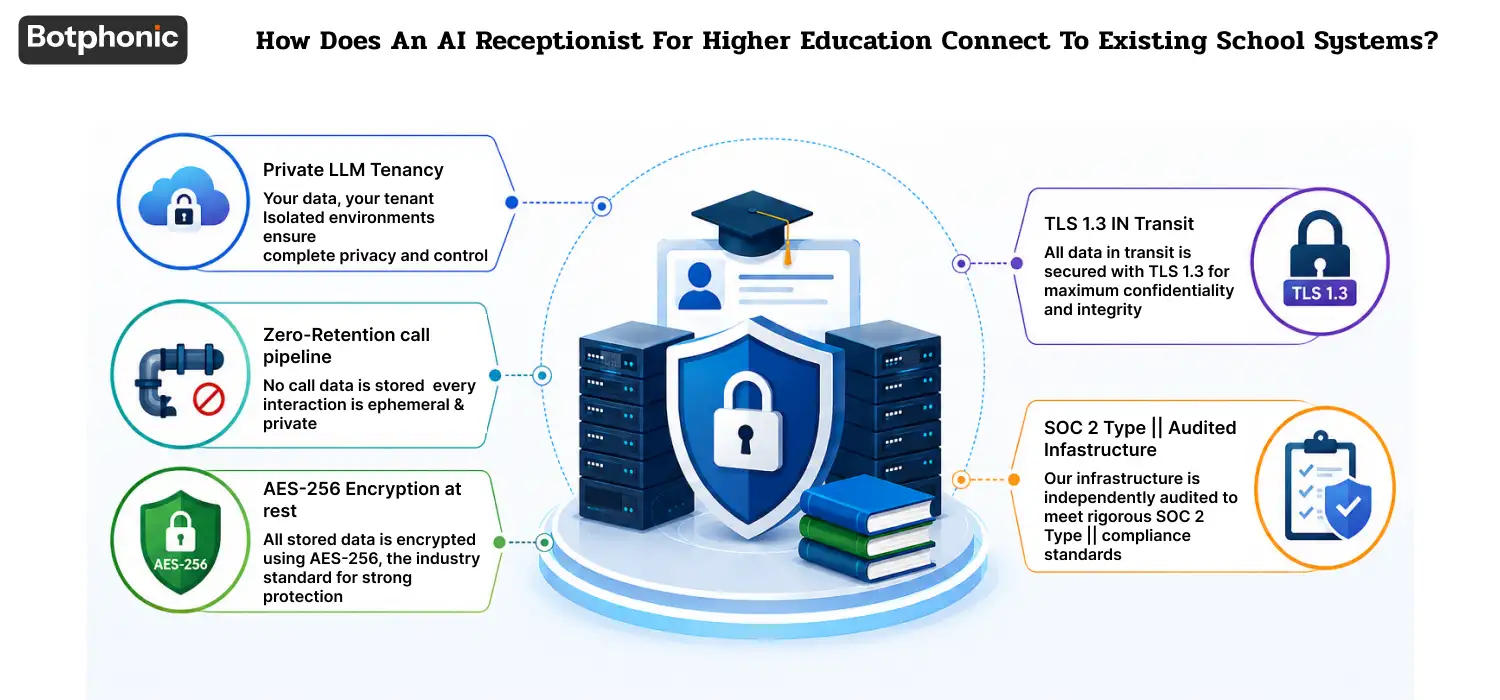
Botphonic’s school deployment architecture enforces the following controls at the infrastructure layer:
- Private LLM tenancy: Each district operates within an isolated model inference environment. Call transcript data does not feed into shared model training pipelines.
- Zero-retention call pipeline: A private speech-to-text engine transcribes raw voice data, which the system converts to structured JSON attendance or dismissal records. The platform then pushes these records via authenticated RESTful API to the district’s SIS and deletes them from Botphonic’s processing environment within the same session.
- AES-256 encryption at rest: The system encrypts all structured records cached during API transit using AES-256-GCM with district-unique key management.
- TLS 1.3 in transit: The system transmits all API calls between Botphonic’s voice processing layer and SIS endpoints over TLS 1.3.
- SOC 2 Type II audited infrastructure: Botphonic’s hosting environment maintains SOC 2 Type II compliance, audited annually by a third-party assessor.
How Does the System Detect and Block Unauthorized Student Callers?
Students occasionally attempt to call in their own absences. A school-grade AI receptionist addresses this through Automatic Number Identification (ANI) verification.
The system performs the following at call initiation:
- Captures the inbound ANI (caller ID) transmitted via SS7 signaling
- Executes a real-time lookup against the district’s authorized contact list, retrieved via a read-only OneRoster 1.1 API call to PowerSchool or Infinite Campus
- If the ANI matches a verified parent, guardian, or emergency contact record, the call proceeds to automated resolution
- If the ANI does not match any record on file, the system routes the call to a live staff member, providing a flagged call summary so they can manually verify the caller’s identity before writing any attendance record.
The system never logs an unverified absence to the SIS under any condition.
How Does an AI School Phone System Handle High-Volume Periods Like Enrollment, Snow Days, and Spring Dismissal?
An AI assistant for educators handles volume spikes by processing concurrent SIP sessions simultaneously across a cloud-elasticated telephony infrastructure. Here is what that means for your district: the August registration rush and the February snow day become operationally contained events rather than all-hands emergencies.
How Does the AI Manage the August Back-to-School Enrollment Surge?
Back-to-school season produces a documented 300% spike in inbound call volume relative to mid-year baselines, driven by parent inquiries about immunization record submission requirements under CDC school vaccination guidelines, supply lists, bus route assignments, and registration deadline windows.
Botphonic resolves these calls by pulling dynamic FAQ content from the district’s published enrollment portal and cross-referencing real-time enrollment status via a read-only SIS API query. Staff receive zero calls from this category during peak enrollment weeks.
How Does the System Prevent Busy Signals During Snow Days and Emergency Closures?
When a district announces a closure at 5:45 AM, hundreds of concurrent parent calls arrive within minutes. A PSTN-limited front-office phone system produces busy signals. Each busy signal generates a callback attempt, compounding the volume.
We provision Botphonic’s cloud telephony layer on elastic SIP trunking, allowing unlimited concurrent calls at the application level. Every inbound call connects on the first attempt. The system delivers a closure notification generated from the district’s emergency communication record, sourced via an authenticated API call to the district’s mass notification platform (compatible with Blackboard Connect, ParentSquare, and Remind), and logs timestamped call records for the district’s communication audit trail.
How Are Mid-Day Spring Dismissal Changes Processed and Delivered to Teachers?
The system processes dismissal changes received mid-morning through the following workflow:
- Parent calls and states the dismissal change (e.g., “My daughter Maya Torres needs to leave at 1:30 PM today with her grandmother”)
- Botphonic’s NLU engine extracts the student name, dismissal time, and authorized pickup contact
- The system executes an ANI lookup against the SIS authorized contact list to confirm caller identity
- Upon successful verification, the system writes a structured dismissal record to the SIS via an authenticated POST request to the Infinite Campus or PowerSchool REST API.
- The system delivers a push notification to the classroom teacher’s dashboard within the SIS interface.
- The front-office staff receives a confirmation log entry, no phone tag, no pink slip, no manual data entry
What Are the Real-World Use Cases for AI Call Handling in a School Office?
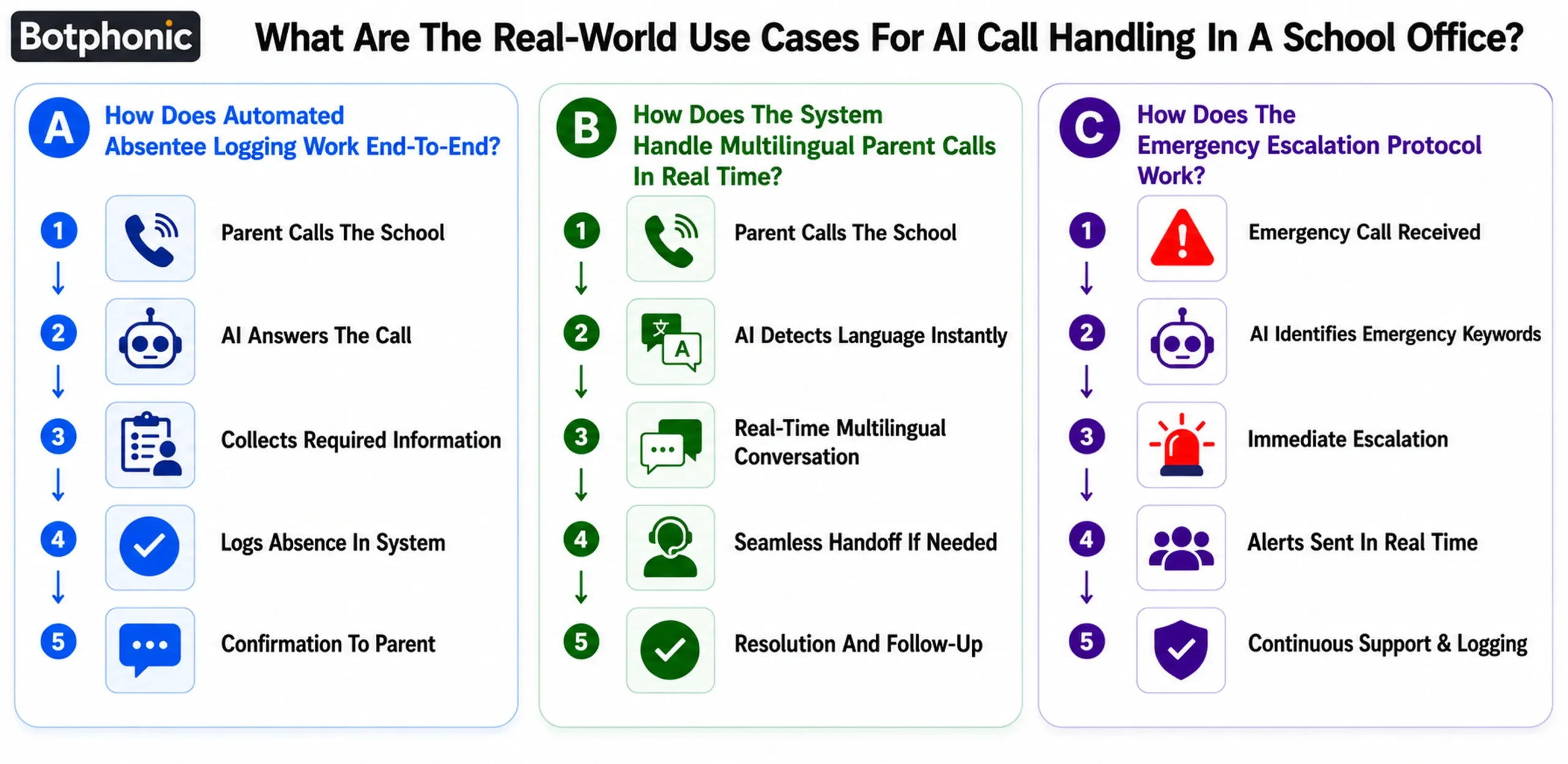
Real-world AI call handling in schools covers three operationally distinct scenarios: structured absence logging, multilingual parent communication, and emergency escalation. Here is what each looks like at the system level.
Scenario A: How Does Automated Absentee Logging Work End-to-End?
A parent calls at 7:22 AM to report a sick child. The end-to-end workflow executes as follows:
- Botphonic’s SIP endpoint receives the inbound call; ANI is captured and matched against the SIS authorized contact list via a read-only OneRoster API query
- The NLU engine classifies the call intent as “absence report” with a confidence score above the configured threshold (default: 0.92)
- The system conducts a structured dialogue to capture: student full name, absence reason (mapped to district attendance code taxonomy), and expected return date
- A structured JSON payload is assembled and submitted via an authenticated POST to the PowerSchool Attendance API endpoint or equivalent SIS REST interface
- The attendance record is written with an ISO 8601 timestamp, caller ANI, and a Botphonic session ID for audit traceability
- The parent receives a verbal confirmation; the call terminates; the voice session data is deleted from Botphonic’s processing environment
The front-office staff sees a clean, coded attendance record in their SIS dashboard. No manual entry, no transcription error. No call log to reconcile.
Scenario B: How Does the System Handle Multilingual Parent Calls in Real Time?
In districts where 20–40% of households speak a primary language other than English, a pattern documented in NCES data on English Language Learner enrollment, a monolingual front-office workflow creates systematic communication failure.
Botphonic’s multilingual engine operates as follows:
- Language identification runs on the first 2–3 seconds of caller speech using a dedicated language detection model
- The system dynamically switches the active NLU pipeline to the identified language (Spanish, Vietnamese, Arabic, Mandarin, and additional languages based on district configuration)
- Dialogue, confirmation prompts, and structured record extraction all execute in the caller’s identified language
- The structured attendance or dismissal record is written to the SIS in English, using the district’s standard field taxonomy, regardless of the call language
No hold time. No dependency on a bilingual staff member being present on shift.
Scenario C: How Does the Emergency Escalation Protocol Work?
When a caller uses a phrase matching Botphonic’s pre-defined safety keyword taxonomy, including terms mapped to custody disputes, medical emergencies, missing student reports, or restraining order violations, the system executes the following escalation sequence:
- NLU keyword match triggers an immediate halt of the automated call flow
- The system issues a SIP REFER transfer to the designated emergency extension, configured per site in the Botphonic admin console
- The transfer is executed as a priority flash ring, the target extension rings continuously without going to voicemail until answered
- A real-time call summary, including caller ANI, matched keyword, and transcript excerpt, is pushed as an alert to the designated staff member’s notification channel (Google Chat, Microsoft Teams, or email, per district configuration)
This escalation path is enforced at the application layer and is not overridable by end-users or building-level administrators.
NOTE :
An AI receptionist is most effective when it handles routine calls and automatically routes complex or sensitive situations to school staff for human review.
What Does Implementation Actually Look Like, and How Do You Get Staff to Accept It?
Implementation of a school AI call assistant follows a 90/10 operational framework: automate the 90% of calls that are routine and classifiable so that staff allocate their full capacity to the 10% requiring human judgment, de-escalation, or direct student interaction. Here is what that means at the district level.
What Does the 90/10 Call Automation Model Look Like in a Real School Office?
A mid-sized elementary school front desk receives an average of 60–80 inbound calls per day during peak instructional weeks. Approximately 85–90% of that volume falls into five classifiable intent categories:
- Absence reporting
- Dismissal change requests
- General schedule and calendar questions
- Bus route and transportation confirmations
- Immunization record and enrollment status inquiries
Botphonic’s intent classification model is pre-trained on K–12 call corpora for all five categories. Calls matching these intents resolve fully within the automated flow. The remaining calls, custody concerns, accommodation escalations, behavioral incidents, or unclassifiable intents, transfer immediately to a live staff member with a structured pre-call summary delivered to their screen before they answer.
Staff are not replaced. Their call queue is replaced.
How Do You Address Front-Office Staff Concerns About AI Replacing Their Roles?
Front-office staff who hear “AI Receptionists in Higher Education Admissions” frequently interpret it as workforce displacement. That concern is operationally incorrect and should be addressed with data, not reassurance.
The accurate framing: the AI system absorbs the call volume that currently prevents staff from performing higher-value tasks. A front-office coordinator who is managing three simultaneous phone lines cannot also provide a student in distress with focused attention. Botphonic removes the phone queue. It does not remove the coordinator.
District administrators should present pre- and post-deployment call volume analytics at staff onboarding. Showing staff that their daily interruption rate drops from 70+ calls to fewer than 10 escalated handoffs per day is a more effective communication strategy than any reframing exercise.
For districts operating on Google Workspace for Education or Microsoft 365 Education, Botphonic delivers escalation alerts and daily call summary reports directly into existing Google Chat spaces or Microsoft Teams channels via webhook integration. No new application login. No additional training requirement.
Is an AI Receptionist for Schools Worth the Investment? A Front Office ROI Checklist
An AI receptionist in higher education delivers quantifiable ROI by eliminating manual call-handling labor, reducing unlogged absences, and preventing SIS attendance entry errors caused by manual transcription. Here is an audit matrix for superintendents and IT directors benchmarking their current phone infrastructure.
Districts scoring “partial” or “variable” on three or more of these metrics are operating a phone infrastructure that functions as a compliance and operational liability.


Comments
Post a Comment